
I had a conversation with a friend last month where she was playing a social worker for a drama class. It was a really fun phone call as she asked some interesting questions around social work and the role she was playing. (My friend was trying to understand why her character would react and respond a certain way in the given situation). Throughout the phone call more questions came up that got me thinking about past work experiences I had as a social worker, as well as thinking about friends that are still in the field. Therefore, I reached out to a couple of friends to do interviews with, to give my readers a broader understanding (hopefully) of the things that social workers need to face in their work, and also to help explore it more for those who may be considering it as a career choice.
Below is 1 of 2 interviews regarding the social work field. The one today is with Mackenzie Broomfield. She discusses her past and current experiences, as well as a glimpse into her private practice. I do find there is somewhat of an overlap between social work and counsellors, career and life coaches… really anyone in the “helping profession”. So without further ado… please allow me to introduce Mackenzie Broomfield!! :0)
___________________________________________________________________
A little Q & A with Mackenzie:
Brandy (B): Why did you become a social worker?
Mackenzie (M): I wanted a job that made me feel like I was helping people. In my own past, I had been supported by a social worker during a few different periods, so I was already familiar with the role. When I was looking to go back to school, I reached out to a number of agencies that I imagined working at to ask what type of education they required; among the various professionals they hired, ‘social worker’ was the common denominator. So that is what I pursued. First, I completed the Social Work Diploma at Mount Royal University, and then I completed the Bachelor of Social Work at the University of Calgary.
Brandy (B): Was it what you expected it would be?
Mackenzie (M): Honestly…yes and no. The typical “social work” jobs are pretty much what I imagined…although, some of the unethical politics in the industry have shocked me and been a struggle. But having my social work degree led to qualifying for other jobs, like an Instructor for a couple of career colleges in their Community Support Worker or Social Service Worker programs. Then my teaching led me securing a contract to develop a Community Support Worker program for another career college that was introducing that program into their catalogue.
That experience, coupled with my palliative care experience, led me to securing a role facilitating palliative education programs with a nation-wide non-profit organization, and in facilitating a support program for people living with cancer and their families for a non-profit organization in Calgary.
So, obtaining my degree really led me down paths I had not initially imagined.
B: Fair enough! And also seems like a common thread with those entering social work… there are a lot of avenues one could go after completing the degree program. With that said, during your schooling, were classes like addictions, mental health, sexual health and loss & grief mandatory, or electives?
M: There was an Addictions and Mental Health course in my diploma program at MRU, but the rest were electives.
B: Same here. Most were electives for me too. One random, but were you expecting as much Math skills needed to be a social worker?
M: Lol, no; and I always say, “I’m a social worker; I don’t math.”
B: Haha! That’s awesome! I always found it fascinating how much math would be needed in the various roles. I used to say I wasn’t an accountant for a reason, lol!!
Which brings me to another question… Which (type of) positions did you like the most? And the least?
M: I like positions that are independent, although I think most social work positions are…well, they are a mix of half independent and half a team player. Although I loved working in DV (domestic violence), I did not love some of the responsibilities involved with working in the shelter, such as managing unattended children. I also can’t stand being micromanaged, but that has more to do with management style than actual social work positions.
B: That’s completely understandable. I also found social work to be fairly independent but still need to cooperate and work within a team setting (whether it’s with clients, colleagues, managers, other professionals to help connect your client with)… there can be lots of involvement and competing demands at any given time. With that said, do you find social work to be a rewarding job? And with that… What is the “best” part of your job? And the hardest?
M: I am actually going through a job change right now. And since I graduated, I typically have one full-time job and multiple part-time jobs. Currently I have four part-time/casual jobs. I was working full-time in palliative care for a major organization and part-time for an online wellness company. Working in palliative care was my dream job, the role I was striving for throughout my entire four years in university. I was passionate about the work, I loved my clients, and it felt so rewarding to support patients in the final days and weeks of their lives. But the pandemic caused a lot of burnout, and then management changes altered our team environment. The atmosphere became really toxic. And then a situation occurred that really challenged my ethics…something that was actually illegal and unethical…and I was not supported by management in advocating for the best interest of the client. For the first time ever, the line between work and my personal life blurred; I was not able to leave this problem at work life I typically would. I was waking up with clenched fists and flexed feet, and at times I was crying at work.
And so I left. I dug deep and realized that my part-time employer had been my biggest support over the last few years. So now I am in the process of growing my client base there. The company is a wellness and fitness company that recognizes that mental health is a part of complete wellness. I work one-on-one virtually with clients around goals, habits, behaviour changes, communication skills, and anything they want to work on, really.
But what is most exciting for me is that I launched my private practice. I provide online and in-person supportive counselling and life coaching. I am also a Certified End-of-Life Doula and a Certified Pet Death Doula, and I have worked those services into my private practice. As well, a previous employer (the career college) reached out to me, and I partnered with them to create a series of eight seminars on various topics related to grief and loss; facilitating those seminars at private Independent Living facilities is also a part of my private practice.
As well, I still work multiple times a year facilitating groups/courses with two non-profit organizations.
B: That is a very honest answer and very much appreciated. It is very sad that it is not uncommon for social workers to have to face some difficult choices when working within a company/organization. There’s doing right by your client, doing what your told and doing what feels like the most ethical or moral thing to do. I am sorry to hear you went through that, but also applaud you for recognizing the need to leave. And very proud of you for starting your own private practice!!
B: Let’s switch gears a little… We are a pet loving community and I know you have some beautiful photos to share of your sweet fur babies. Could you please tell us about them? :0)

M: We have Finnigan on the left. He is a Chocolate Dapple. Hannah is the black and brown (now grey!) one. Hannah will be 16 on March 21st, and Finnigan will be 6 next month.
B: OMG!! They’re soooooo cute! 😍 Let’s include a few more pics for our readers today.. Because seriously it’s hard to choose just one! And what little personalities they must have!

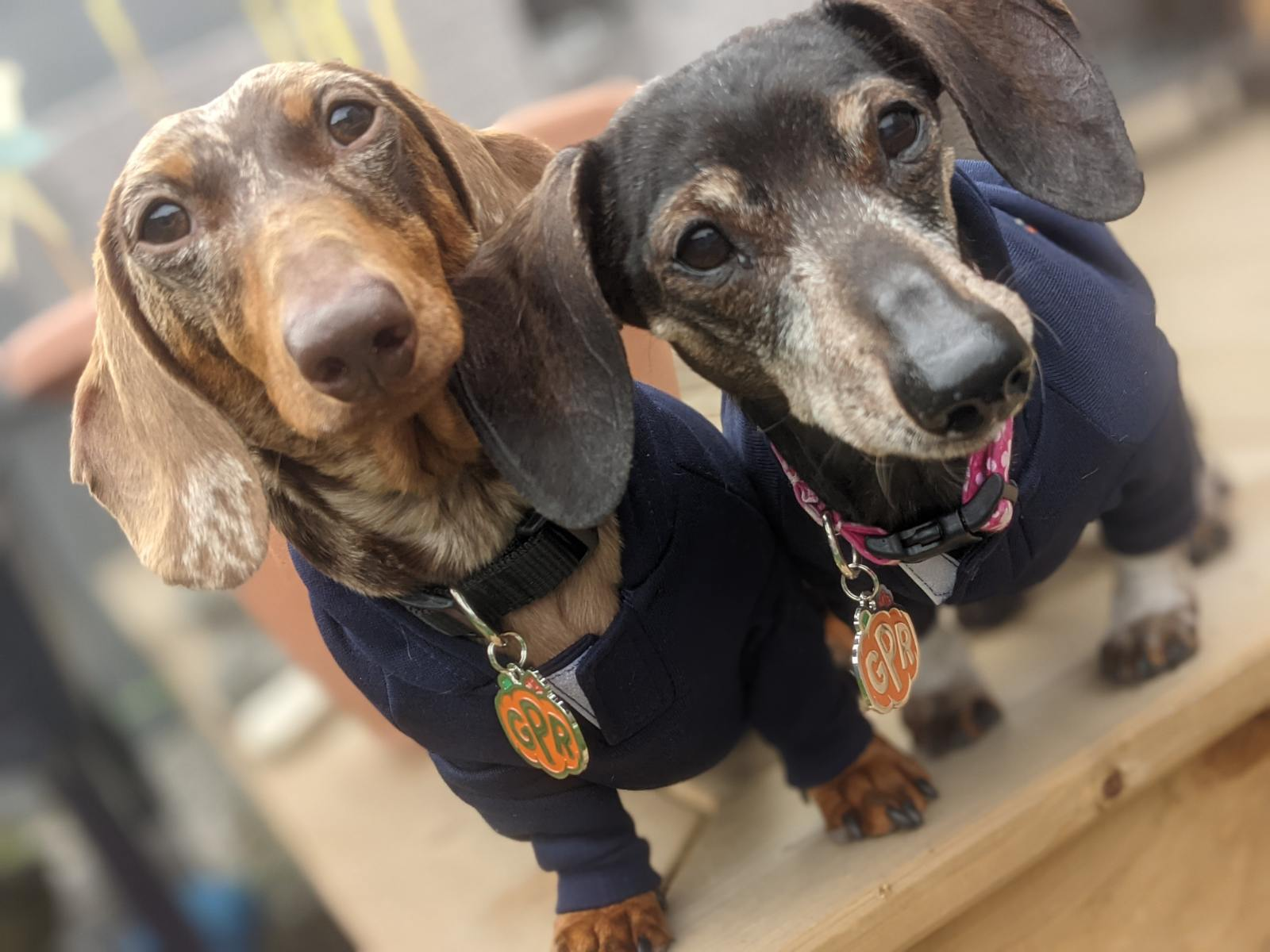

M: Yes! My Hannah is my soulmutt (the more light brown one). She is independent (as long as you are paying attention to her…), stubborn, friendly, and just so very precious.
Finnegan is my little man, and he is almost 6-years old. He is the best pup ever. He has anxiety issues (got him from a breeder at 8 months, and I am sure they never socialized him), but he is the best listener and my fiercest protector.
B: They are amazing! Thank you for sharing with us!! Pets are wonderful companions and can definitely help us when having a more stressful day. Could you share with us what you do to calm down? Also, what do you do for FUN?
M: Honestly…it is much easier for me to preach self-care than to practice self-care – it’s an issue most helping professionals have.
B: Yes! That is absolutely true!! LOL!
M: (One thing I do) is I have really good boundaries. It really isn’t like me to take my work home. Lol, that’s funny because I work from home a lot. I did have to turn the spare room into a home office so that I would stop working in areas such as the living room or my bedroom – that was making work bleed into my personal life. Now that I have a home office, that mental boundary has been solidified again for me.
I also do yoga regularly.
Being someone that often works multiple jobs, doing “fun” things got pushed aside a lot. But over the last year, I started to prioritize that more. Most recently I have been doing a dance class, going to a swim class, taking Finnegan to Agility, and going to the movies.
I also love travelling and camping. And I love having adventures with my youngest kiddo and my dogs.
B: Those are all really great ideas and boundaries are very important! You also made a good point with how you work on limiting work “bleeding” into personal life, especially with working a lot from home. With this in mind, do you prefer to cleanse your energies with things like “fire” (so candles and incense), or “water”… so baths, showers, etc. Do you have other methods for cleansing energies?
M: I do both. I frequently have a candle lit. I also have bubble baths or sit in the hot tub regularly. Sometimes, I gather up a bunch of candles and have a bubble bath; lol, so I guess I mix fire and water.
I also smudge. And I actually find yoga a spiritual practice as it is the time that I express gratitude to the universe for all the blessings I can see and for all the blessings I cannot see.
B: Awesome! I love to mix cleansing techniques as well.
Switching back to the whole social worker piece… Do you have any advice you would like to give for someone who is thinking of becoming a social worker? Or what skills do you think a person needs to be a good social worker?
M: I think boundaries is one of the biggest things a social worker needs – good boundaries can prevent a lot of problems for both the worker and the client.
I also think social workers really need to know themselves, their thoughts, their beliefs, and how they feel about different subjects – they need to know all of this about themselves so that they can recognize and interrupt themselves when they are putting their own beliefs onto their clients.
Which brings me to the next thing – a social worker must believe in the self-determination of all clients, even when they are making choices that we wouldn’t personally make for ourselves. A social worker must believe that a client will be just fine without them; there is no room in this profession for thinking that you know best or that you have to save someone.
And I think that a social worker must believe in the worth of all people and uphold their rights and dignity. People are worthy simply because they exist.
B: I would agree greatly with everything you just said. Well put, thank you!
Something that is very common in that field is “burn out”. What do you do to prevent it, and how do you recognize it?
M: I think anyone trained as a social worker can recognize burnout…for those in the helping profession, I think it is more important to be able to admit that it can actually happen to us. I was definitely burned out during the first and second year of the pandemic, and it led me to doing my job half-assed and not taking care of myself; I just kept telling myself that I could do one more day.
What I should have done was admit to myself that even I can get burned out. The simple act of admitting it would’ve changed the way I did things – I would’ve taken on less, I would’ve utilized all my sick time to take some mental health days, I would have truly prioritized self-care.
During that time, my office hours were done from home. I had really good boundaries in the beginning – not working after 4:30pm; putting all my work stuff away each night (laptop, phone, etc.) – but I started to get really lazy about it and I would just leave my stuff on the kitchen table, and I would work late because I hadn’t been effective during the day.
Then I attended a seminar in which the speaker [talking about all of our work-stuff being around our homes] said, “We all think that we are working from home, but in reality, we are living at work.” That really opened my eyes to the fact that I am literally living at work when I don’t put away my work-stuff each night. When I leave it on the kitchen table all weekend, I lose the mental boundary between home and work.
So, I think the most important ways we can prevent burnout is boundaries, admitting that it can happen to us, and true prioritization of self-care (which I define as both making healthy choices and doing things that make us effortlessly happy).
B: All very good points! Just going through my list here of questions… What about Loss and Grief… do you have any particular resources?
ME! I am an amazing resource! Lol.
Seriously, though, after 10 years in palliative care, I have a ton of good resources, including 8 seminars that I created on various topics related to grief and loss. People could sign up for upcoming seminars on my website (www.inua.ca) and I am in the process of creating a resource page (bear with me – building a website is soooo much work!!)
B: Yes it is! That is awesome you have a website up. Very useful! What about parenting/working with children… resources or websites you would recommend?
M: I do not work with children, but I am certified in child development, and I do support some clients with parenting practices. I also have good resources for children experiencing grief. People could reach out to me for those, or watch for that resource page that I am creating for my website.
B: Awesome! Thank you!
As a side thought… We worked together at Robertson College teaching the Community Service Worker classes. What did you enjoy in that teaching role? What do you think is one thing to remember when in this line of work… like a certain approach to have with clients, or a skill set, personality trait…. And so on??
M: I was actually surprised how much I liked teaching. I went on to teach at another career college and now facilitate groups.
The one thing I always tried to impart on my students is this:
When you are with your clients, it is not about you. This is just your day at work, you are getting paid for this. BUT this is your client’s LIFE. When you go home, they are still living this. It. Is. Not. About. You.
B: That is a very important piece of advice!! I remember when I went through the social work program at university, the professors kept drilling into us that we were not “the experts”. And as I got further into the field, I was reminded a lot that the client may share things with us but it doesn’t mean we know what’s best for them. They still have to live their life and have a right to make their own choices.
Thank you Mackenzie for taking the time to share about your experiences in social work. Should anyone be interested, I have included your website info and ways to contact you below.
To anyone reading today’s post, I hope you have found this helpful in understanding the social work role a little better. Please note the next post will be an interview with another friend in a different area of social work… but it goes to show just how large a field it is, but how certain pieces overlap in terms of personality traits, etc that are needed when considering working in this type of role.
Take care and have a lovely day!! :0)
_________________________________________________________________
Mackenzie Broomfield:
Inua ᐃᓄᐊ Counselling and Support Services
Website: www.inua.ca
Email: support@inua.ca
FB: Inua ᐃᓄᐊ Counselling and Support Services
IG: @inuacounselling
LinkedIn: Mackenzie Broomfield
 333 The Spiritual | Brandy Marie
Leave a comment