
(original journal entry/ blog post July 2019)
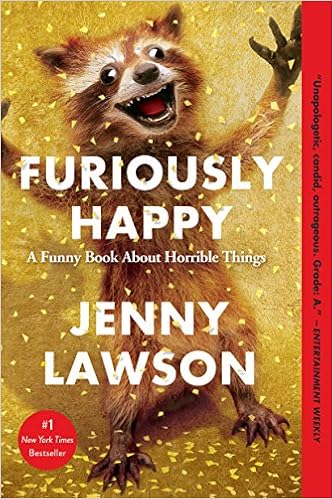
My friend had recommended this book to me years ago and I borrowed it from the library and fell in love with it! About a month or so ago I decided I wanted to read it again, and knowing how much I liked it the first time around, I decided to buy it. This book is written by Jenny Lawson, who also suffers from anxiety. She is very candid and puts a humorous spin on everything. She also gives a great perspective on how even though sometimes her anxiety can be a lot to handle for herself and her family, she still sees the positive in it. After all, as she says, if she didn’t have these issues she wouldn’t have these things to write about and wouldn’t have gained the amazing popularity she did by being honest about her struggles. I find this book to be very uplifting and super funny. Not everyone may find it this way and that’s ok! This is just my opinion about the book. I did find it to be helpful because it made me feel less alone during a more heightened stressful and chaotic time in my life. So who knows… maybe you will find it helpful too! 😉
One of the major ideas that came out of this book that I thought would be helpful to share is “The Spoon Theory”. (Jenny Lawson learned this from her friend, Christine Miserandino, as mentioned on page 241 in the book). The general idea behind this is that people have a certain number of spoons that they’re born with and each spoon symbolizes the energy used to complete a task. As described in the book, a ‘spoon’ is used when take a shower, work, even play with your kids or pets. When you wake up in the morning you start out with a certain number of spoons and it may not be enough to do everything you want to do. When you go to sleep you wait for more spoons to arrive the next morning, but the more depleted you are to begin with, the harder it will be for having lots of spoons the next day. She also explains how having chronic illness or anxiety can deplete your level of spoons even quicker. For a healthy person, he or she is more likely to have a larger supply of spoons (and I would add that maybe those spoons are stronger or made of silver, unlike my ‘spoons’ that I swear at times are made out of plastic or paper sometimes and barely allow me to have enough energy for simple daily tasks). Either way, the point of “The Spoon Theory” is to help not only the person with the illness, but hopefully allow for a better way to explain the struggles and fatigue that comes with chronic illness to family and friends. If you don’t have these kinds of conditions then your spoon supply is probably stronger and can accumulate more quickly and easily just through getting enough sleep the night before. I would like to add that sometimes we may need to get a little help from coffee to jump start our “spoons” (our energy levels), but not everyone has as easy of a time to have that bounce in his or her step after a cup of coffee. Some of us need coffee, sugar, and a shot of pure adrenaline to get going in the morning. However, this may only help you temporarily get going so you can complete some tasks, but inevitably you still have a limit to your supply of spoons and that coffee in the morning may help that morning, but then there is the afternoon crash. Then you have to decide if you should have another cup of coffee to get through the afternoon but have to consider what that means come bedtime. And I think if you do that you’re actually now borrowing from tomorrow’s spoon supply. So you may do well today, but tomorrow might be that much harder because now your supply for tomorrow is already down before that day even begins.
These are just some thoughts that came from the initial “Spoon Theory”. The other thing Jenny Lawson points out with this theory is how easily we compare ourselves to others. It is hard to want to do all these tasks, whether they’re fun activities or just regular work hours. It is frustrating to see others looking like they are doing it daily and have an endless supply of spoons. And then you think to yourself, “well what’s wrong with me?” And then maybe you have family or friends who cannot understand or appreciate your fatigue and need to recharge in seclusion. Then you just sit there and compare yourself to those who seemingly have it all figured out and able to move mountains if so choose, and you’re just happy to be breathing. This is where Ms. Lawson makes a funny comparison to Galileo. She has a point in saying that she’s doing better than him simply because she is alive (and breathing)! I think that’s a brilliant comparison! We shouldn’t be so focused on others’ abilities. We need to appreciate the fact that everyday we get up and try. We try to do all the tasks that are set out and sometimes some tasks will simply have to wait for another day.
There are other ways to look at this theory too… it doesn’t have to be spoons. It can be jellybeans! Whatever works for you is just fine. I have often thought it would be interesting to actually make this more of a visual theory in my house by having a jar with spoons and remove some throughout the day to illustrate to myself (and remind myself), just how much energy is being used that day. I have not done this yet as I am unsure how many spoons I would need to start out with, as well as deciding a number for each task so I know how many spoons to remove.
There are a lot of other wonderfully amusing stories throughout this book. Jenny Lawson does talk about her husband, parents and her daughter and some of their responses to her behaviours. I really enjoyed reading this book because it made me laugh and gave me a boost in believing that I am not alone with my anxiety and the strange happenings in my life. This book does have some curse words sprinkled throughout, but I find it just adds to the flavour and overall fun and vibe of the book. If you decide to read it I hope you enjoy it, or at least find something positive to take away from it.
Have a wonderful, and hopefully spoon-filled day! 🙂
——————————————
*2023 update*
I still come back to this book from time to time. It’s just silly and a fun reminder that you have to laugh at yourself sometimes. Besides, laughing is way better than crying!! 😉 I have found that the more I give my anxiety a purpose, like a need to protect myself in that moment, then I can become calmer. I am better able to slow my heartbeat and slow down any racing thoughts. Otherwise it is much harder for me to focus, to hear what anyone around me is saying… especially when it comes to my spirit guides. Honestly until I started to explore more about my spiritual beliefs, I kind of just thought my anxiety was going to take over or would be a constant battle. Even though I still have anxious days, (and on those days I usually experience more body pains, aches and fatigue), I am able to connect with my guides and ask for help. In doing so I don’t feel as afraid or alone. I can better concentrate on what my next step is, and sometimes it’s just an “I need a nap” moment so I can recharge. Also, I have found that during those naps I have vivid dreams and through those dreams am able to connect more with my guides. Upon waking from a dream I can look into dream interpretations while using my tarot and oracle cards for extra guidance. So even though the anxiety attack can be unpleasant, by taking a break and having a nap, I am able to restore some ‘spoons’ and gain some clarity on a message brought forward by my guides.
I hope this has been a helpful post for someone! As usual, sending lots of hugs, love and light.
Brandy Marie 🙂
 333 The Spiritual | Brandy Marie
Leave a comment